From AI Hesitation to AI Fluency
I built the systems, culture, and cross-functional partnerships that helped a hesitant design team become confident contributors to AI-enabled product development.
+85% designer pull requests in 3 months
Role: Design leader
Scope: Product Design team, in partnership with Engineering
Timeframe: Three-month initial rollout
Focus: Organizational change, AI fluency, Design–Engineering collaboration
The challenge
AI was changing the boundaries of product design, but the team’s confidence and experience were uneven. We had no shared definition of AI fluency, no consistent workflow, and no safe path from experimentation to meaningful contribution.
The leadership challenge was not simply teaching new tools. It was creating the conditions for people to learn quickly, take thoughtful risks, and carry design intent closer to implementation.
The strategy
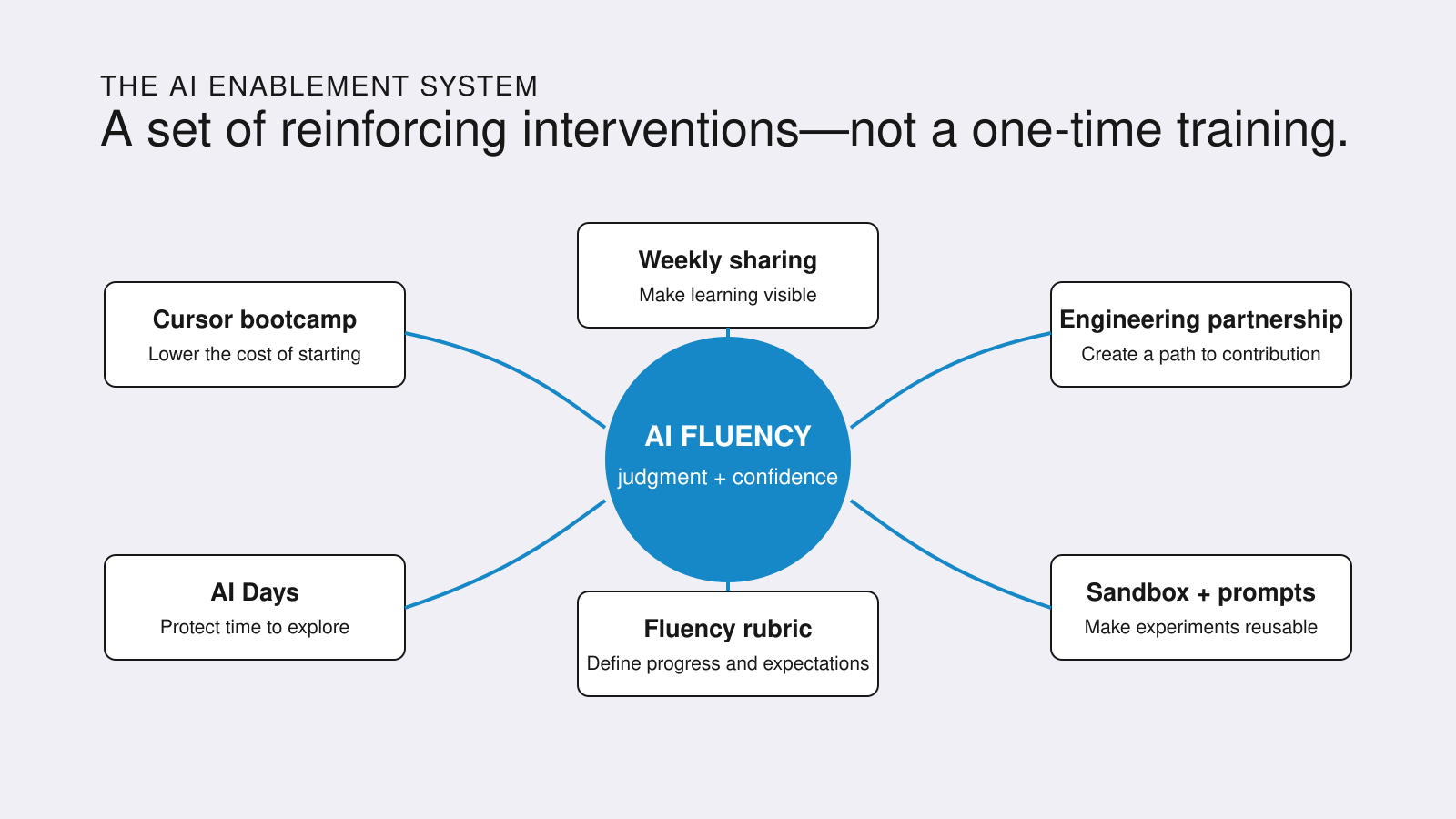
I built a system of reinforcing interventions rather than a one-time training program:
Cursor bootcamp to lower the cost of the first attempt
AI Days to protect time for experimentation
Weekly sharing to make successes, failures, prompts, and tools visible
AI sandbox and prompt library to make learning safer and reusable
Engineering partnership to enable coded prototypes and reviewed contributions
AI fluency rubric to define growth and set clear expectations
Creating momentum and safety
I launched a hands-on, two-day Cursor bootcamp because active experimentation mattered more than passive demonstrations. Designers practiced framing prompts, evaluating output, recovering from errors, and deciding when AI was—or was not—useful.
The bootcamp created momentum, but the surrounding system made it sustainable. AI Days provided protected time. The sandbox reduced risk. A weekly sharing thread normalized learning in public, including failed experiments. The prompt library turned individual discoveries into team knowledge.
Together, these mechanisms made experimentation safer and helped people adopt new workflows at their own pace.
Expanding Design’s contribution
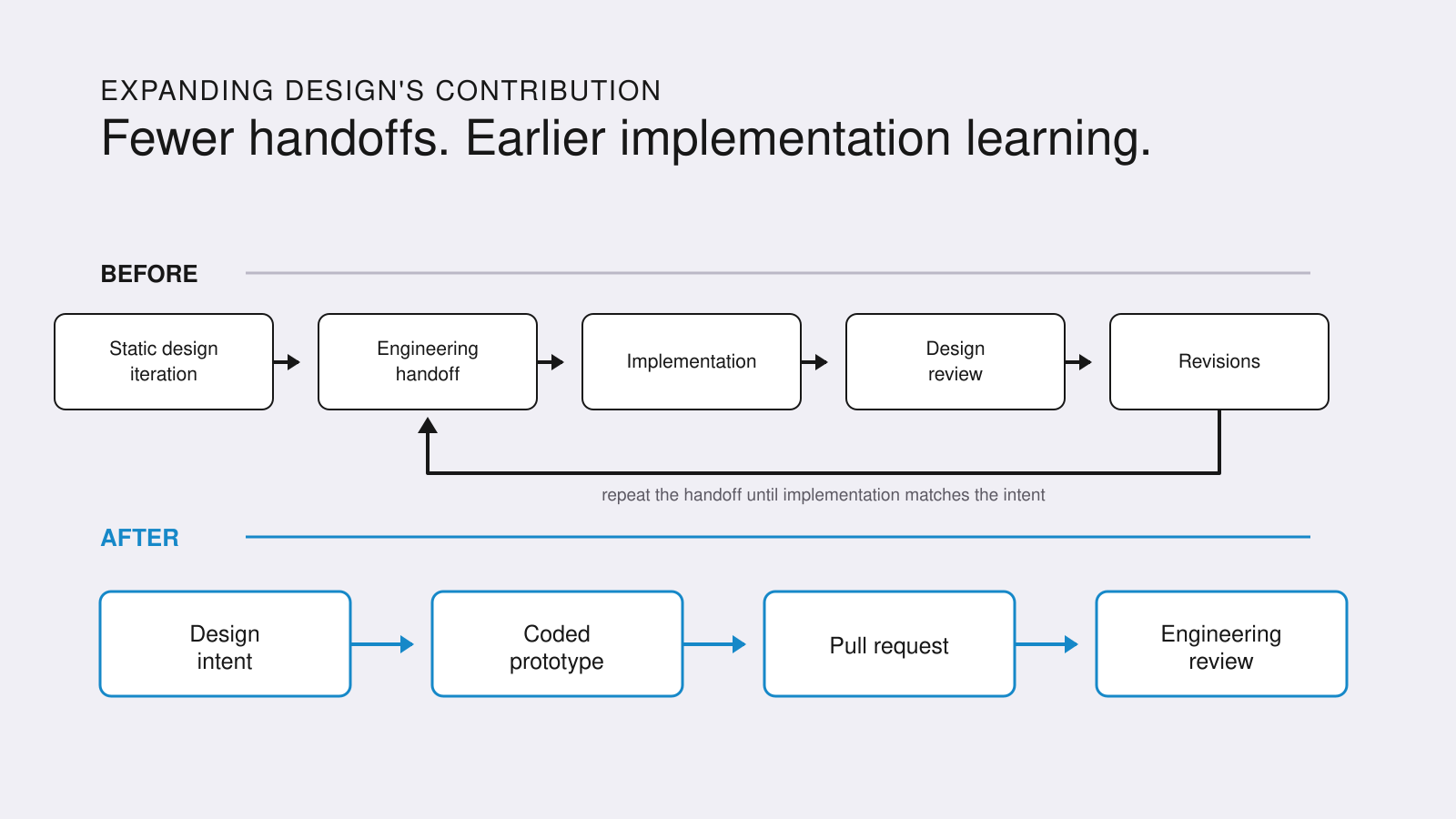
I partnered with Engineering to create a responsible path for designers to move directly from design intent into coded prototypes and established development workflows using tools such as Cursor, Claude Code, GitHub, and GitLab.
The goal was not to turn designers into engineers. It was to make ideas more testable, surface implementation constraints earlier, and expand the ways designers could contribute—with Engineering review providing the appropriate technical guardrails.
Defining AI fluency
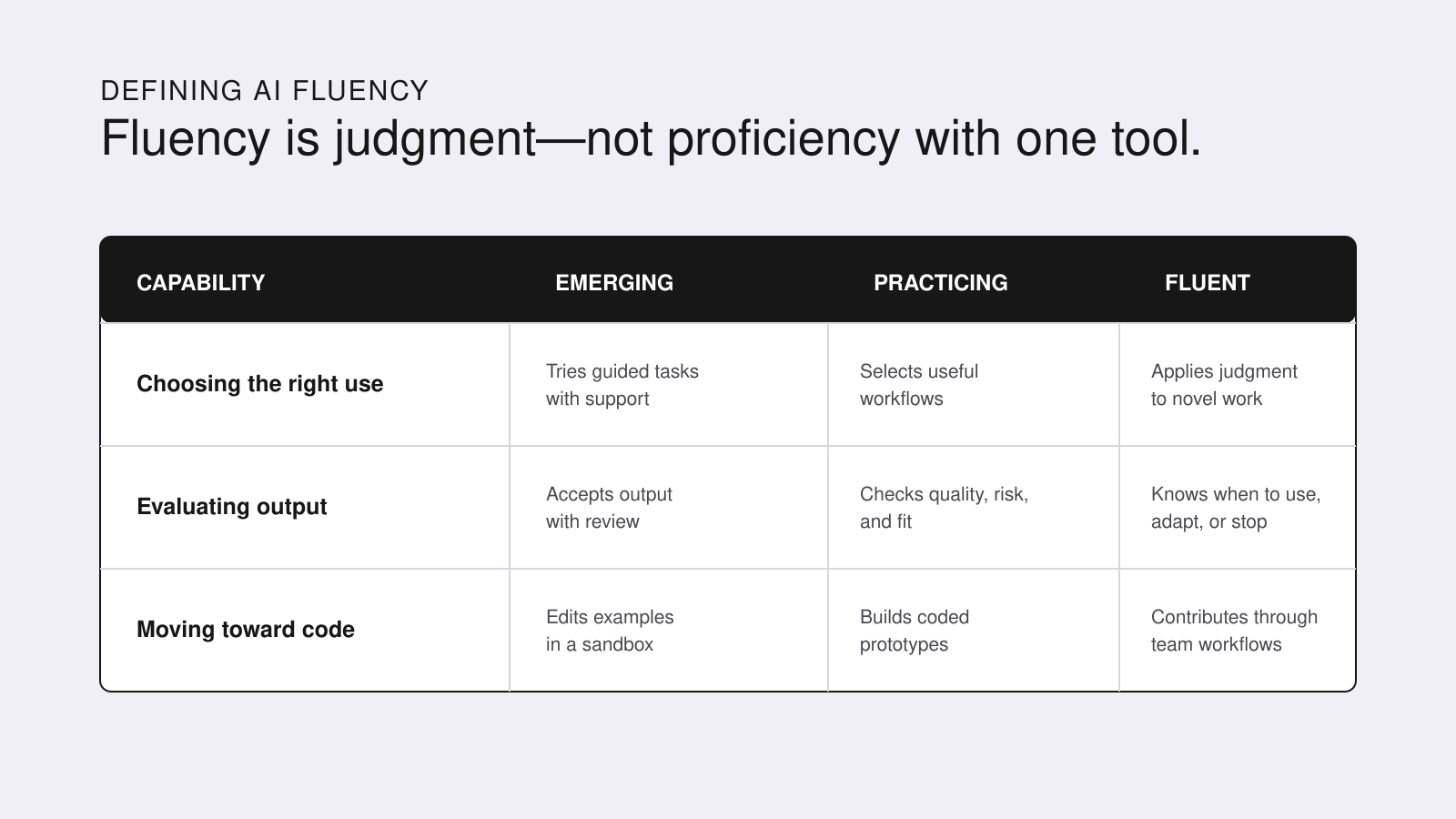
I developed an AI fluency rubric and integrated it into the broader Product Design competency and leveling framework.
Fluency did not mean proficiency with one tool. It meant knowing where AI could add value, providing useful context, evaluating output critically, protecting quality and security, applying human judgment, and sharing reusable learning.
This shifted AI from an optional side interest into a durable organizational capability.
Results
+85%
Increase in designer-authored pull requests within three months.
The team also showed greater confidence, more autonomy, higher-fidelity coded prototypes, earlier implementation learning, and closer collaboration with Engineering. Designers became meaningful code contributors within the broader Product, Engineering, and Design organization.
What I learned
Organizational transformation requires a system, not a training session. People adopt change at different rates; durable progress comes from combining psychological safety, protected time, practical infrastructure, shared expectations, and cross-functional trust.
AI did not diminish design craft. It expanded where designers could create value—and made judgment even more important.